Attention spans and cutting rhythm

March 11th, 2010

Last week, Mr Gray sent me a photocopy from the New Scientist about a paper from Cornell University that analyses attention span and cutting rhythm in Hollywood movies. Their methods involved analysing cuts and shot length, and comparing them to biological rhythms of human attention span. Essentially what they have achieved is an mechanical version of film editor Walter Murch’s “blink of an eye” theory. He suggests that thoughts and blinking are connected (we blink when we “cut” in our minds from one thought to the next) and by being aware of where one blinks while watching rushes (and also by watching when good actors in the movies blink) you can tell when a cut will feel “right” emotionally.

Some of the sources reporting on this story lazily conclude:

The researchers concluded that over the next few decades film makers may take more care to follow the 1/f law to try to boost audience engagement.

This is almost the exact opposite of what the authors of the paper really conclude:

In no way do we claim that there is any intention on the part of filmmakers to develop a 1/f film style, even if they knew what that might be. Instead, we claim that, as explorations and crafting of film have proceeded for at least 70 years, film narrative has fallen naturally into 1/f shot structure as the myriad of other considerations in filmmaking have played against each other in shaping film form. Good storytelling is the balancing of constraints at multiple scales of presentation. Thus, we view 1/f film form as an emergent, self-organizing structure (Gilden, 2001; Van Orden et al., 2003), not as an intentional one.

It seems to me that the underlying assumption of the paper is, however, that shots in a movie can only carry one idea and need to be cut once that idea has been communicated. This is not a satisfactory way to understand the achievement of films that make use of sequence shots. Many high-grossing Hollywood movies of the “classical” period made much use of long shots with complex camera movements. This style leads – and holds – the viewer’s attention without fast cutting, and in some cases without cutting at all. An extreme example is Hitchcock’s Rope which is intended to be one long sequence shot with no cuts. A better example, because its style was emulated for commercial and artistic reasons, is the following shot from Preminger’s The Man with the Golden Arm

Between 2:44 and 6:01 of this shot there are no cuts whatsoever. That’s ONE SHOT that lasts 3 minutes and 27 seconds. The Man with a Golden Arm was a commercially successful film which paved the way for Hollywood movies to explore the subject of drug addiction. It would also not fit the cutting model proposed by Cornell’s scientists at all. Why, then, was something so antithetical to natural human attention span so successful?

Well, put simply, cutting isn’t the only way to direct a viewer’s attention. As for why it was used, and why this style has fallen out of use, attention span is only half the story. In this period of film history the studio system was at its height. Camera crews worked together regularly in the same sound stages, and it was easy and – as Preminger proved – cheap to shoot movies using this extended take sequence shot style. An added artistic advantage is that it allowed actors time and space to create subtle, nuanced performances. Furthermore, this style allows the viewer time to investigate the space within the frame, picking up on small details.

It is notable that the films that fit most closely with the attention span formula of the Cornell team are action films. Certainly when you’re planning to cut very quickly, you seldom have time for more than one idea per frame. As Mr Gray noted in biro on the bottom of the photocopied article:

[Is it] that modern films have less to look at, that their compositions and choice of inclusions have grown simpler due to a simplifying market?

It is worth noting that the film the Cornell scientists observed to adhere most rigidly to the 1/f shot sequence structure was The Phantom Menace.

Links:
The New Scientist: Cine-Maths grabs our fickle attention
Attention and the Evolution of the Hollywood Film

Wind in my sails

November 29th, 2009

It’s funny how humdrum everyday employment manages to eat up so much mental bandwidth. I’ve had almost no brainwaves worth blogging in months. Dull, dull, dull. But now the becalmed feeling is GONE. The day job finished over a week ago, and since then we’ve shot a music video and I’m about 70% through editing it. Fantastic! It is so good to be master of my own schedule again, even if it’s just for a few weeks.

Fewer kids = greener?

September 29th, 2009

I love reading well-written arguments from different sides of the global warming polyhedron.

First: Contraception Fights Global Warming from Salon.com

Second: The Population Myth from Monbiot.com

Personally, (and, I confess, as someone who has no plans to procreate) I found the Salon article quite convincing at first, but was wondering how the numbers stacked up. It was reaffirming to read George rightly pointing out that the groups experiencing the largest population growth are normally the ones who contribute the least per capita to carbon emissions.

Blowin’ in the Wind in Japanese, kind of…

August 18th, 2009

What happens when you translate the first line of a Dylan song into Japanese and back over and over again until it translates into the same English phrase twice?

You get a very mangled lyric which somehow still scans.

A Lesson in Framing and Disclosure

August 16th, 2009

Chris Marker’s Junkopia is watchable online. I really love the framing and the rhythm of the cutting in this piece, and the way each shot of an object reveals a different aspect depending on angle and context, both spatially and within the film’s own timeline (“narrative” seems too strong a word). There is something reminiscent of Ozu’s little transitional sequences here.

A rainbow-coloured fish in Chris Marker's

The film was shot in Emeryville, near the east section of the Bay Bridge, but unless I’m mistaken the co-ordinates in Marker’s intertitles appear to be for somewhere in Redwood City.

Dune

May 1st, 2009

Kyle MacLachlan and Sting face off as Patrick Stewart officiates in Dune's climactic fight.

David Lynch was thrust into development of Dune too early in his career, it seems. The producers’ idea was to profit on the success of Star Wars by creating another sci-fantasy epic, but a standard length feature film is not a big enough container for Dune, with all its plotting, counter-plotting and Messiah-creation.

I’ve now seen both the original theatrical release, on which Lynch has the director’s credit, and the TV edit, which is attributed to Alan Smithee. It was the Smithee version that I just watched. The producers, showing an absolutely dreadful grasp of the possibilities of film, front-load about three hundred years of exposition using a dull voiceover and a bunch of hastily assembled paintings, some of which recur multiple times. The aim, apparently, was to save time in order to cut to the action quicker, but seeing as it takes about ten minutes to outline everything, it is deathly, deathly boring.

I think most people who are aware of Dune know that Lynch had to struggle to trim his rough cut from about four hours down to about two and a half, and that as a result the story is unclear and under-motivated. It feels as if a missed opportunity flies by every five minutes, but despite this, there is still something interesting buried in the narrative rubble. Much of the time the production design is evocative and hints at a society that exists beyond the screen, and there is something that sticks with you in the dream sequences — which is what you’d expect from Lynch’s direction. Performances from Kyle MacLachlan, Max von Sydow and Patrick Stewart are commendable, and there’s an almost unparalleled moment of male objectification when Sting steps out of a futuristic shower clad only in a large white nappy while his uncle, an evil duke, coos and drools over him.

Probably the best way for Dune to be brought to the big screen is as a trilogy, pitched somewhere between the original Star Wars movies and the Lord of the Rings. One would hope the latest crew to attempt to make it would dig Lynch’s early four-hour rough cut out of the archives as part of their research, because as imperfect as it is, there is something worth salvaging.

Quote from number9dream

April 9th, 2009

The missus is re-reading David Mitchell’s number9dream for the dissertation. Every now and then she reads a bit aloud for me.

I watched for a while longer. Not much happens in Paris Texas.
“Sort of slow, isn’t it?”
Buntaro licks his hand.
“This, lad, is an existentialist classic. Man with no memory meets woman with huge hooters.”

I really enjoy days when I write and she reads.

A River Runs Through It

April 9th, 2009

A River Runs Through It is Robert Redford’s 1992 period feature about three men and their relationship to God, fly fishing and each other. Seeing as God and fishing are two of the subjects most likely to put me to sleep, I was astonished to find that not only did I stay awake throughout, but that I genuinely enjoyed it.

Brad Pitt and his big fish.

Much of the credit for this film being watchable has to go Redford. His style is relaxed to the point that it appears effortless, but getting this much authenticity into a film takes serious effort. The cast is excellent, Redford allows them time to find their own cadence, and editors Lynzee Klingman and Robert Estrin cut sympathetically with those rhythms. The way that characters continue living outside the boundaries of the frame is reminiscent of Renoir’s French Can-Can; the shots of Montana rivers and mountains are gorgeous without being pretty; the whole thing is so very sensibly restrained and wise that if I were a more religiously informed person, I’d say for certain that it’s designed to evoke the feeling of the Presbytarianism that crops up throughout the film, but as it is, I can only guess.

Read the rest of this entry »

Boston’s on the Ball

April 9th, 2009

You know that festival organizers are on the ball when they send each filmmaker an individual email with a link to where to buy tickets for their film’s screening. Thanks, Boston!

Click here to buy tickets for “Julie, Julie” at the Independent Film Festival, Boston.

Lakeview Terrace

April 9th, 2009

Warning: spoilers after the jump.

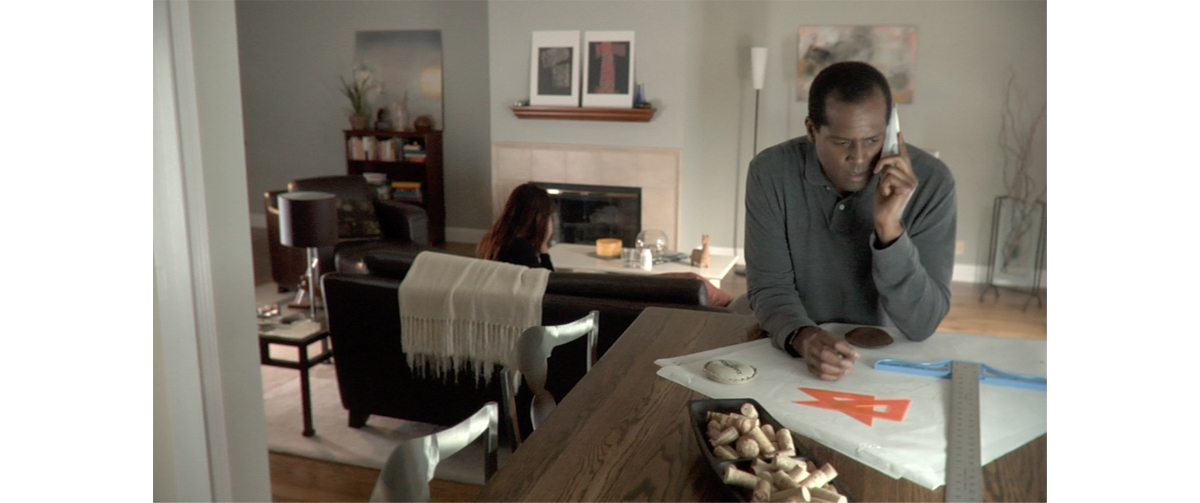
It feels as if Samuel L. Jackson has spent the last few years sliding into self-parody in formulaic big-budget films, so I was keen to see him exercise his craft in Lakeview Terrace, an exploitative little thriller set in the LA suburbs. Likewise with its director, Neil LaBute, who caused a stir fifteen years ago with misanthropic indie movies like In the Company of Men, but whose last credit before this was a nasty-looking remake of The Wicker Man, which I refused to see on principle. The idea of both men reminding us why they’re worth watching by getting back to basics is very appealing.

Samuel L. Jackson, Patrick Wilson and Kerry Washington in Lakeview Terrace.

Lakeview Terrace pushes on the pressure points of race relations. Young bi-racial, college educated, hybrid-driving couple Lisa and Chris Mattson (Kerry Washington and Patrick Wilson) have just moved from Oakland to the LA suburbs and are celebrating their freedom from the supportive but smothering influence of parents. Abel Turner (Samuel Jackson) is their cop neighbour, a friendly and authoritative lawman who works a tough beat in the inner-city and spends his off-duty time policing their suburban neighbourhood for fun. But of course, in films like this suburbia is never what it seems on the surface. The threat to normality is present from the very beginning, as Lisa and Chris check the reports on the summer wildfires to be sure that their new home is safe.

Read the rest of this entry »